Montessori Materials: How Simple Tools Build Focus and Independence
Montessori Material: How Simple Tools Build Focus and Independence
A child walks to a low shelf, fingertips hovering, eyes scanning like they’re choosing a favorite book. They lift one tray with two hands and carry it carefully to a rug. That quiet choice is the start of real work.
Montessori materials are sets of hands-on tools that teach one clear idea at a time. Each item is meant to invite focus, offer a way to check mistakes without an adult, and help a child do more on their own. Instead of entertainment, the materials offer something better: practice that feels satisfying.
What makes Montessori material work so well
Good Montessori material has a strong point of view. It isolates one skill, so a child’s attention doesn’t scatter. The design is clean and consistent, which makes the work feel calm. Many materials use real, child-sized tools, because real objects demand real care.
Another key is sequence. Children move from simple to complex, step by step, like climbing a staircase where each step is the right height. That’s why open shelves matter in a prepared environment. When materials are visible and within reach, choice becomes possible, and choice is where independence starts. If you’re touring a classroom or setting up a corner at home, look for order, space to lay work out, and a clear place to return it.
Control of error, the quiet feedback loop
The best correction doesn’t come from a grown-up’s voice. It comes from the work itself.
- Knobbed cylinders only fit in one matching hole, so a wrong choice leaves a gap.
- A puzzle map piece won’t settle if the shape is off.
- Pouring work tells the truth right away, a spill shows the hand moved too fast.
The child adjusts, tries again, and owns the success.
How guides introduce a material, slow hands, few words
A Montessori guide treats a lesson like a small ceremony. First comes a careful presentation: slow hands, tidy movements, and only the words that matter. The guide might point, pause, and let silence do some of the teaching. Children watch closely because the message is clear: this work is worth your attention.
Next, the child is invited to try, often with the guide nearby but not hovering. If the child forgets a step, the guide may repeat the action instead of correcting with lots of talk. Finally, the guide steps back. Repetition is welcomed, not rushed. A child might choose the same Montessori material many days in a row, and that’s not “stuck,” it’s building strength.
From demonstration to creativity, without turning it into a toy
After mastery, freedom grows. Creativity can look like making new patterns, aiming for smoother motion, or choosing a harder version, while still using the material with care and purpose.
A real example: the Pink Tower, and how it changes over time
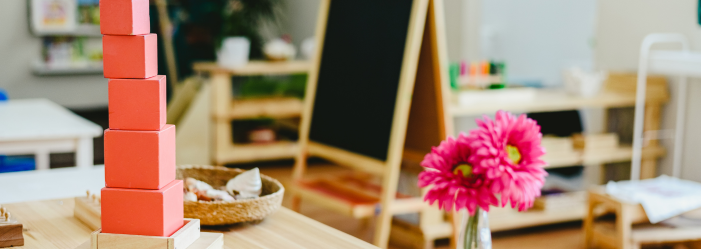
The Pink Tower is ten pink cubes that stack from largest to smallest. In the first lesson, a child carries one cube at a time, sets them down neatly, then builds the tower with steady hands. They compare sizes by sight and touch, then return each cube to the shelf in order.
Later, the same material opens new doors. A child may build on a larger rug to give their arms room. They might line the cubes up like a stair, noticing each change in size. Some children pair the cubes with number cards, counting as they build. Language can join in too: big, bigger, biggest. With permission, the Pink Tower may even be combined with another sensorial material for deeper comparison.
Conclusion: What parents can watch for
If you’re wondering whether Montessori material is being used well, keep it simple:
- Are the materials complete, within reach, and treated with care?
- Are adults correcting less and observing more?
- Does the child repeat work by choice?
That pattern, choice plus repetition, is where confidence grows. To see these materials in action, you can schedule a visit with Sandwich Montessori School using this page: Schedule a tour at Sandwich Montessori School.
Or, if you're looking to see your child in a real Montessori environment, learn more about our Caregiver program. See your child discover an array of Montessori materials in real time.