How the Moveable Alphabet Teaches Children to Read (A Montessori Approach)
How the Moveable Alphabet Teaches Children to Read (A Montessori Approach)
The moveable alphabet is one of the most powerful Montessori tools for teaching children how to read and write. Instead of memorizing words or relying on worksheets, children build language with their hands - sound by sound - developing real understanding and confidence along the way.
In Montessori classrooms, reading doesn’t begin with books. It begins with language, movement, and meaningful exploration. The moveable alphabet is where those early skills come together.
What Is the Moveable Alphabet?
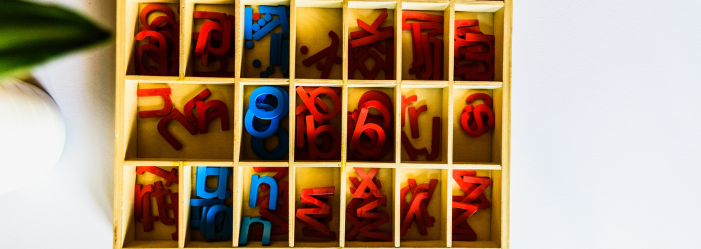
The moveable alphabet is a hands-on Montessori language material made up of individual wooden letters that children use to build words.
Rather than writing with a pencil right away, children are able to select letters, arrange them into words, and physically manipulate sounds. This allows them to focus fully on language and phonics without the added challenge of handwriting.
How Children Use the Moveable Alphabet
In one common activity, a teacher may introduce a simple word ending, like “-at.”
A child is then invited to explore how changing the beginning sound creates entirely new words. As they build combinations like sat, cat, hat, and fat, they begin to see patterns in language.
As each word is formed, the child says each sound, blends the sounds together, and begins to recognize the word as a whole. Often, they will then write the word down, reinforcing the connection between spoken and written language.
This process turns reading into an active discovery rather than something to memorize.
What This Activity Teaches
The moveable alphabet supports foundational reading skills in a deeply meaningful way.
Children begin by developing phonemic awareness as they hear and isolate individual sounds in words. As they work, they naturally connect those sounds to written letters, strengthening their understanding of how language is constructed. Through repetition and exploration, they learn how to blend sounds together to form words.
In Montessori, children often learn to write before they read fluently, and the moveable alphabet plays a key role in this process by allowing them to build and encode words before decoding them.
Beyond academics, this work builds confidence, independence, and a strong sense of capability.
What Age Is the Moveable Alphabet For?
The moveable alphabet is typically introduced in the Primary classroom, between the ages of three and six.
Children are ready for this work after they have developed strong spoken language and have been introduced to letter sounds, often through materials like sandpaper letters. From there, the moveable alphabet becomes a bridge between hearing sounds, building words, and eventually reading independently.
How Montessori Teachers Adjust the Activity
One of the strengths of the moveable alphabet is how easily it can be adapted to meet each child where they are.
For children who are just beginning, the activity may be simplified by focusing on only one or two sounds at a time. At this stage, the emphasis is often placed on hearing and saying sounds aloud, rather than writing, allowing the child to build confidence without added pressure.
For more advanced learners, the activity can be extended by introducing more complex sound combinations such as blends or digraphs. Children may begin building longer words, writing full sentences, and reading back what they have created, deepening both their reading and writing skills.
This flexibility allows each child to move forward at their own pace, following their natural development.
How the Moveable Alphabet Builds a Love of Reading
When children use the moveable alphabet, they are not being asked to memorize or perform. They are discovering.
They begin to notice that changing just one letter can create an entirely new word. They experience the satisfaction of figuring something out on their own and start to see themselves as capable learners.
Instead of frustration, children experience curiosity, confidence, and joy in the process of learning.
Over time, this grows into something much bigger. A child who feels successful begins to believe, “I can read.” That belief turns into enjoyment, and eventually into a genuine love of reading.
See the Moveable Alphabet in Action
This activity is just one small piece of how children develop into confident, capable readers in a Montessori environment.
If you’d like to see how reading unfolds from the earliest years through elementary, we invite you to join us at Sandwich Montessori School for our upcoming parent event:
Cultivating Lifelong Readers - March 31st: RSVP Here
You’ll have the opportunity to step inside our classrooms, observe real materials like the moveable alphabet in use, and learn how our teachers support each stage of reading development.