The Capstone Years
There are key times in children’s lives when they can consolidate emerging parts of themselves before moving into a new area of growth and change. Two significant times of change for young people are around age six and then again around age twelve, the kindergarten and 6th-grade years. Both biology and Montessori theory offer insight into why these are significant times in children’s lives.
Montessori’s Planes of Development
Dr. Maria Montessori believed that children’s work is to construct the adults they will become. This is really important work! Adults can support children’s own self-construction, but not actually do it for children. Children are able to accomplish self-construction through their own activity and interactions with the environment.
Dr. Montessori’s observations of this self-construction led her to develop a theory of four planes of development. When looking at children’s development from a scientist’s point of view, Dr. Montessori found that development did not occur steadily but rather occurred in phases or planes. Dr. Montessori considered that the change in children, as they moved from one plane to another, was so profound that it resembled a rebirth.
Each plane or phase of development lasts for approximately six years: infancy (0 to 6), childhood (6 to 12), adolescence (12 to 18), and adulthood (18 to 24). The turning point around age six is when children are moving from infancy into childhood, and similarly, around age twelve they move from childhood into adolescence.
Biological Changes
Biologically, considerable hormonal changes are happening during these two transition times in children’s lives. While our society generally recognizes the biological shifts that happen as young people move into adolescence, we are less well-versed about what happens in our six-year-olds.
It doesn’t take much, though, to realize change is afoot! Think about what we see in terms of dramatic physical changes around age six: their teeth start to fall out, their hair gets coarser, they lose that baby-soft skin, and they start to become leaner and lanky. Similarly, our twelve-year-old’s are on the brink of adolescence, another period of dramatic physical growth and change.
However, there can be a gap between these physical signs of maturity and the cognitive and emotional development happening for our six-year-olds and twelve-year-old’s. Often children at these ages are moved too quickly into an environment that both doesn’t meet their needs and doesn’t honor the internal growth that still needs to occur. When this happens, they lose the environmental stability that allows them to develop a deeper sense of self-confidence and to truly consolidate the intellectual and emotional skills they have been developing over the previous years.
Capstone Years
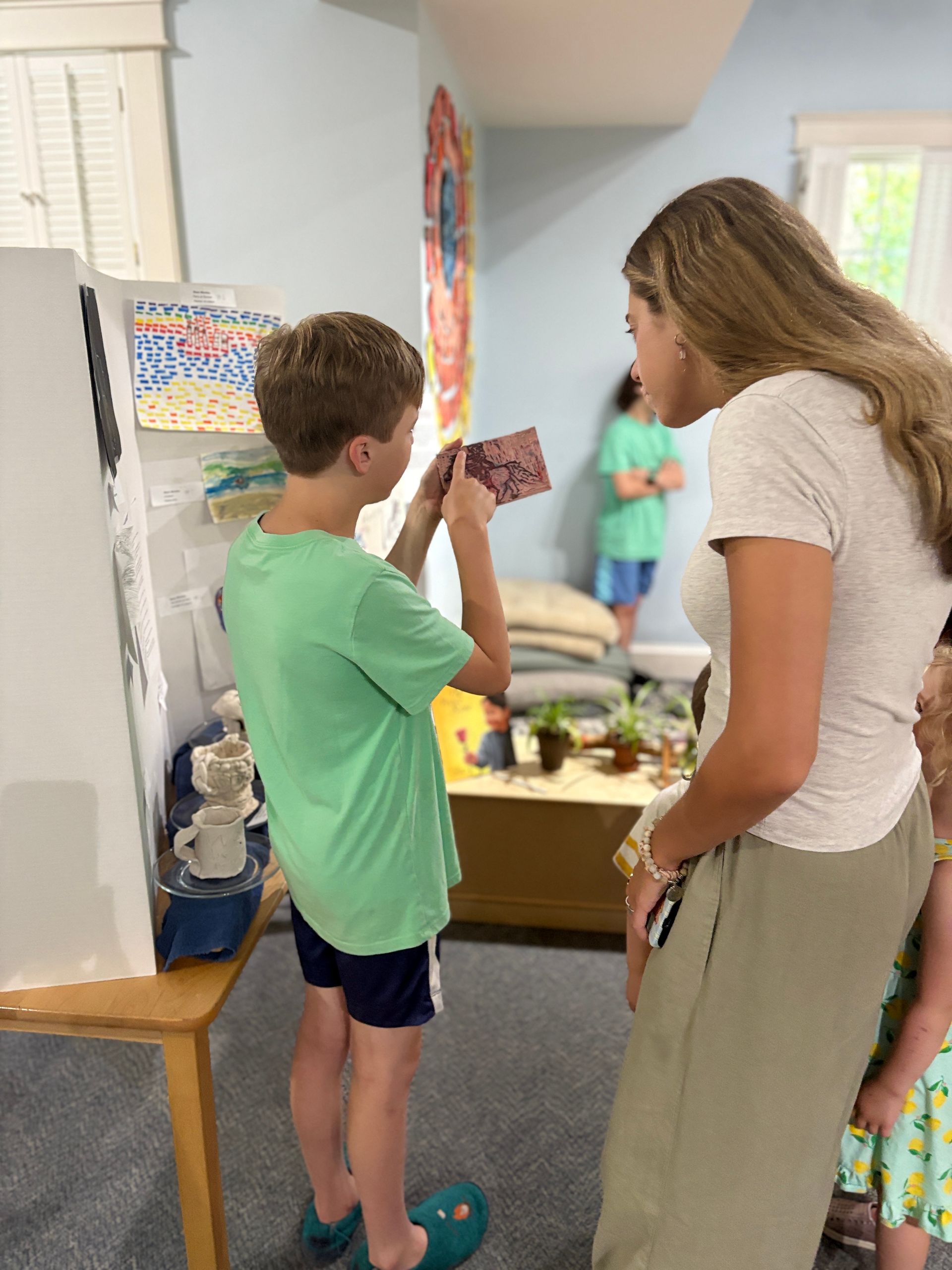
In Montessori, we recognize the importance of these transitional years and intentionally design our learning communities to support young people during this time. The six-year-olds and twelve-year-old’s are the oldest in their classroom learning communities. They know the routines and expectations, they have secure relationships, and they get to help others who are newer to the classroom communities.
Because they aren’t trying to assimilate into a new environment, our six- and twelve-year-old’s can serve as leaders for their mixed-age classrooms. They can focus on challenging work and big personal achievements. By being with their younger classmates, they can see where they have grown and how they got to where they are now.
These are the capstone years, the final piece to complete the critical building-up that has been happening during the previous formative years. The level of mastery allows our young six-year-old and twelve-year-old leaders to integrate their social, emotional, and intellectual selves.
During these capstone years, children gain a sense of self-confidence and self-satisfaction from their ability to successfully navigate the bigger projects that were beyond their capabilities in the earlier years. Plus, they do so in a community of adults and peers who have shared in their learning experience over several years.
By having the opportunity to integrate their learning in a safe, stable, and secure environment, our young learners can do their important work of self-construction. We invite you to visit our classrooms, so you can see for yourself the significance of these capstone years.