5 Traits Nurtured In the Montessori Environment
5 Traits Nurtured In the Montessori Environment
When we choose a course of education for our children, we ask ourselves a lot of questions. At some point, we begin to wonder how various models align with our own personal values. What’s really important? What should the goals of education be? What do we want our children to gain from the experience?
It all depends on why and how the methods were developed. What were the initial goals when a particular approach was conceived? What do current practitioners value? These are important questions to consider.
In a list like this, you might be expecting one of the items we feature to be independence. While it’s true that we work hard to build a sense of independence in the children we guide, we talk about it so much we figured it might be nice to focus on some of the other traits that are nurtured in a Montessori environment.
When it comes down to it, Montessori educators care deeply about the academics we teach, because we are curious people who are fascinated with the world around us. But we’re passionate about other things, too. We want the children in our care to go out into the world feeling good about themselves, caring about others, and excited about what they do. That’s what drives our work. That’s what makes us feel so strongly about what we do.
Without further ado, here are five traits Montessori educations nurtures in children:
1. Kindness
Interpersonal skills are some of the most important skills we can teach our students. They can learn all the math and language arts skills out there, but if they can’t interact with other people their lives won’t feel overly fulfilling. More than that, we think humans can accomplish so much more together than individually, so we may as well learn to get along with one another.
The very structure of the Montessori day allows for time dedicated to planned and spontaneous lessons about kindness. We read stories that teach children how to handle hard situations. We use role-playing games to make the work fun. And when a conflict happens in the classroom or the playground? We teach children skills in the moment. How do we handle our own emotions? How do we communicate with someone we disagree with? What does it look like to disagree but still respect one another?
Sometimes the work consists of giving children the script to work through solving issues. Sometimes we enlist the help of the whole group, discussing problems and asking for solutions without targeting individuals.
2. Powerful Work Ethic
The Montessori approach focuses on intrinsic motivation. Extrinsic motivation can be effective in small doses and with short-term goals, like when you don’t want to do the dishes and reward yourself with an iced coffee afterward. Those types of rewards, however, are not particularly effective at cultivating a deep motivation to learn or help others.
Some people find it shocking that Montessori schools don’t give grades, have tests, or hold award ceremonies. The real world doesn’t function like that, so why should we teach children one type of motivation and then expect them to switch to something else as adults? Are employees evaluated at work? Absolutely. The thing is, they’re not receiving grades; they receive narrative feedback that highlights their areas of strengths and what they might improve on. We do the same with our students.
You’ve likely heard the argument that instead of saying “good job” to our children, we should replace that with observations such as “I notice you worked really hard on that. How does it feel to complete it?” Putting the emphasis on a person’s efforts, rather than our judgment of their accomplishments, helps nurture a developing sense of internal motivation.
Rather than focusing on accolades, our students grow with a desire to solve problems, gain insights, and pursue their passions.
3. Creativity
Put simply, Montessori encourages creativity in two main ways: we incorporate the arts whenever possible, and we give children a chance to find their own solutions to problems.
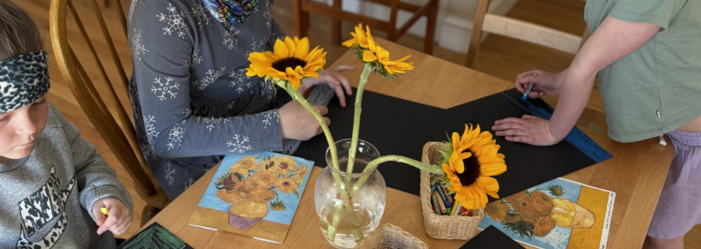
Montessori guides integrate art education in countless ways. Here are just a small sampling of what may happen in classroom during the course of the year:
Drawing, labeling, and painting maps
Listening to music or learning the traditional dance of a culture being studied
Using collage to review and label the external parts of a fish
Reading biographies about influential artists
Teaching sewing or weaving as practical life
As mentioned, the other side of creativity involves the way we encourage our students to think. We do not simply feed them all the answers. We give lessons, sure, and provide students with factual information. But when they run up against a problem we don’t race to give them the solution. Whether it be social, academic, or something else altogether, we ask guiding questions that lead the child to generate their own possible solutions.
This, we believe, is one of the keys to developing innovative mindsets.
4. Joyful Learning
When it comes to creating joyful learners, intrinsic motivation and creativity are a pretty good start. Combine that with copious amounts of freedom and gorgeous autodidactic materials, and you have an environment that kids simply cannot resist.
We think learning is fun, or at least it should be. Otherwise, what’s the point? We really are invested in helping our students become adults who love to learn and pursue learning independently for the rest of their lives. Even the most basic of skills can be delivered in ways that are exciting. Take the Montessori positive snake game for example: it’s a game, and it involves making snakes out of colorful groupings of beads, then eventually transforming the snake until it’s entirely gold. But what’s it really about? Learning how to exchange smaller numbers to make ten in preparation for multiplication work.
5. Service-Mindedness
We believe it’s of critical importance to give our children a sense of the world as a whole and to really see the ways in which everything is connected and interdependent.
This belief is embedded into our curriculum, and most easily seen in our history lessons. In lower elementary, children learn first about the beginnings of our universe, followed by the formation of Earth, then the evolution of life on our planet. Later on, they explore early humans and early civilizations. It isn’t until adolescence that they begin to learn about more recent periods in history.
This is intentional. We believe learning about those who have come before us instills a sense of gratitude and dedication to others.
We also make a point of launching student-driven service projects. These tend to start small, and may focus on the school community. As students get older, their capabilities and visions expand outward into the greater local community. These projects look different every year, because they’re student-led.
These five traits are really just a glimpse of some of Montessori’s most revered values. There are plenty more. Want to see for yourself? Call us to schedule a tour or observe in a classroom.